An interesting fact about the real estate market in Thailand is that while this sector is not fully regulated, over 75% of non-Chanote title deeds belong to the Thai Government and are part of the Kingdom of Thailand. Before buying a property in Thailand, especially as a foreigner, it is crucial to know about the different land title deeds available in Thailand so that you can make an educated decision and choose a property that is right for you.
Below is a summary of the different land Titles you can find in Thailand.
Thailand’s Land Title Deeds Explained
There are a few different types of land deeds in Thailand that you should be aware of when buying a property in Thailand.
Although this guide will explain each land title deed available, it is recommended to speak with a lawyer with the correct expertise in Thai land deeds when buying a property to make sure that they are correct and that you understand what type of property you are purchasing.
Sor Kor Nung
Also commonly known as SK. 1, the Sor Kor Nung land title is, in short, a form of possession of the property. This notification form does not hold complete real rights to the land. At the very maximum, it entitles the property owner to use that particular plot of land for activities such as farming. In most cases, the person who occupies the land has a higher right over the notification form holder. This type of land is usually and commonly sold or transferred for will, succession, heir, and inheritance purposes in Thailand.
In legal terms, the transfer of the property involves a very simple procedure of handing over the form and ownership of the land from one hand to another. A Sor Kor Nung land title deed does not give the land owner any right to register, lease, or mortgage the land.
If the land is located in a vicinity that allows the title to be upgraded and registered then it can successfully be changed to the Sor. 3 Gor or Nor. And eventually the Chanote title.
Interestingly, in Thailand, the land department has not issued or registered any new titles for Sor Kor Nung land in the last 40 years.
Tor Bor Tor Land Title
A level below the Chanote title and the Nor Sor Gor 3 title is the Tor Bor Tor Title, which in its true essence is a form of either squatters or settlers that have made claims over that piece of land. This claim is usually filed with the district office and in most cases, a minimal amount has been paid towards fees for filing the claim.
The Tor Bor Tor title cannot be registered for both sale and lease. More importantly, no banks will accept the Tor Bor Tor title deed as collateral for mortgages or other types of financing. At this point, people who own a Tor Bor Tor title land, cannot build on it for any purposes, not even for farming and recreational purposes.
Por Tor Bor Ha Title Deed
Also known as PBT5, the Por Tor Bor Ha title deed is in its essence only proof of occupying the land using an assigned tax number as well as payments made for taxation purposes for using the plot of land.
This proof may also include the monetary benefit or value of the land. Such a title is nothing more than an occupancy rights deed and does not show ownership of the land.
Earlier on, in some cases, the occupant ofthe Por Tor Bor Ha title deeds could upgrade the title to that of Sor Khor 1, however, this would depend mainly on the property’s location.
In the latest update that was rolled out in 2005, the Land Department clarified that there is no possibility of issuing title deeds as well as rights documents for this type of land on Samui Island. However, holders of Sor Khor 1, as well as Nor Sor 3 property holders, can submit their papers to upgrade to Chanote title as per the need. This move was made to prevent further land encroaching on Samui Island.
Chanote Title Deed
Commonly known in Thailand as the Nor Sor 4 J, the Chanote title deed is one of the few true ownership deeds to land and is usually part of freehold condo complexes, villas, penthouse structures, and other types of sellable land.
These plots are first surveyed, mapped, and plotted using GPS markers and survey tracking grids. The NS4J title deed can be found most commonly in developed parts of Thailand where the owner of the plot does not necessarily have to publish sales acts. Most importantly such land can be legally and truly subdivided as it has no limitations to be sold, rented out, mortgaged, and leased.
It is crucial to note that the land area that is mentioned in writing for Chanote title deeds should be perfectly marked and accounted for. If the land area is purposely or accidentally mentioned incorrectly then the sale and purchase agreement will have to be adjusted on a pro-rata rate based on the area that is mentioned on the Chanote deed.
For instance, if the owner of the land has mentioned on the title deed that the land has an area of 5 Rai but due to a private survey done, later on, it is discovered that the land is in reality only 2 Rai then this would be seen as a discrepancy.
This would furthermore mean that while making the Sale and Purchase agreement the new buyer would have to pay for a land size of 5 Rai when it is 2 Rai, which is a sheer waste of money.
Rai calculations can be confusing, and the wrong calculation can lead to a costly mistake. That is why we put together a Thailand Rai Conversion Calculator for you to use.
Nor Sor 3 Title and Nor Sor 3 Gor Title
A Nor Sor 3 title hasn’t been measured by the Thai Land Department and, by definition, doesn’t have exact boundaries. A Nor Sor 3 Title is usually the first step in the progression of land titles. This means that the first type of title given to land is Nor Sor 3. The second is Nor Sor 3 Gor, and this title is given to the land once it is measured successfully by the Thai Land Department.
It should be noted that Nor Sor 3 Gor titles, once measured, are, in essence, pieces of land that are awaiting the full title of Chanote. A Nor Sor 3 Gor property has exact boundaries, which also implies it can be sold, transferred, and even given on mortgagee provided it is in the “awaiting full title deed” status.
In the final step to change a Nor Sor 3 Gor title to that of a Chanote Title, the owner of the piece of land has to submit a written application to the Thai Land Department. The application should explicitly mention that the title deed has to be changed from Nor Sor 3 Gor to Chanote Title.
The Land Department will review the application and if there are no objections as well as litigations, then the title is usually changed without any hassle. This entire process of transition from Nor Sor 3 to Chanote Title may happen before the deed is transferred to foreigners in the means of condos or any developed land.
Title Deeds with Possessory Rights
The least favoured of all the Thai land title deeds, the Possessory Rights title has never been successfully measured or substantiated by the authorities. It is only recognized through regular tax payments made by the holder of the title deed at the Administrative Office at that particular location.
Usually, any property with such a possessory right title cannot be sold, mortgaged, leased, or rented and it also has many legal complications that can arise if wrongly monetarized according to Thai laws.
Lease-Hold Properties
Chanote titles are ideal for foreigners as these can be easily and freely transferred into the name of foreigners. Other titles, especially those for leasehold properties, cannot be transferred to foreigners as leasehold properties can explicitly be sold only to Thai nationals.
Foreigners who have a Thai spouse may be able to live in a leasehold property if it is leased to them by their spouse for 30 years or more. If, in case the Thai spouse legally owns a leasehold property in her name and the foreigner doesn’t have a lease in place, then the spouse is given the legal right to rent, lease, or sell the property as she sees fit without consulting her foreign spouse.
Even if a foreigner isn’t married to a Thai national, he can still choose a property that has a leasehold deed, with a minimum term of a couple of years to a maximum term of 30 years. The person leasing the land can choose to build on it but he will only own the building and not the land that the structure is constructed on top of.
Pre-Requisites for the Chanote Title
To be eligible to register the land under the Chanote title, the developer of condo units has to ensure that the entire property is shared between Thai nationals and foreigners as per the Land and Real Estate Laws.
The law dictates that a maximum ownership share of any condo complex ownership for foreigners must not exceed 49%. The law also requires that the minimum ownership of any condo complex for Thai nationals must be less than 51%.
Title deeds such as Chanote land titles are typically pre-registered and are transferred to the new owner provided the title is clear of legal issues such as litigations, amongst others.
Transferring title deeds between the old and the new owner or the developer and the new owner is relatively simple provided the transfer of title fees are paid. While some developers and sellers split the transfer fees by 50-50%, others might need the buyer to pay a bit more. The Sale and Purchase agreement is a must for transferring titles from the old to the new owner.
Government taxes and other maintenance may be applicable for condos. As a general rule, checking this information before signing any documents is a smart move.
Remember that you have to transfer the funds from your bank account abroad to the condo seller’s account for both the token and the full amount. Also, having an escrow account in place that can pay for both government fees and maintenance expenses is a wise way to prevent missed payments.
Land Measurements In Thailand – A Guide for Thai Properties
Thailand uses the metric system of square meters which is widely used by realtors and developers in Thailand. Below is the basic terminology for land measurements in Thailand.
- An area of 1600 sq meters is also known as 1 Rai. It may also be termed as 4 Ngan.
- An area of 400 square meters is known as 1 Ngan. It may also be termed 100 Wah.
- An area of 4 square meters is known as 1 Wah.
- An area that is spread over 1 Acre is known as 2.5 Rai. This is an approximate calculation.
- An area that is spread over 1 Hectare is known as 6.25 Rai. This is an approximate calculation.
A Chart of Property Land Measurements In Thailand
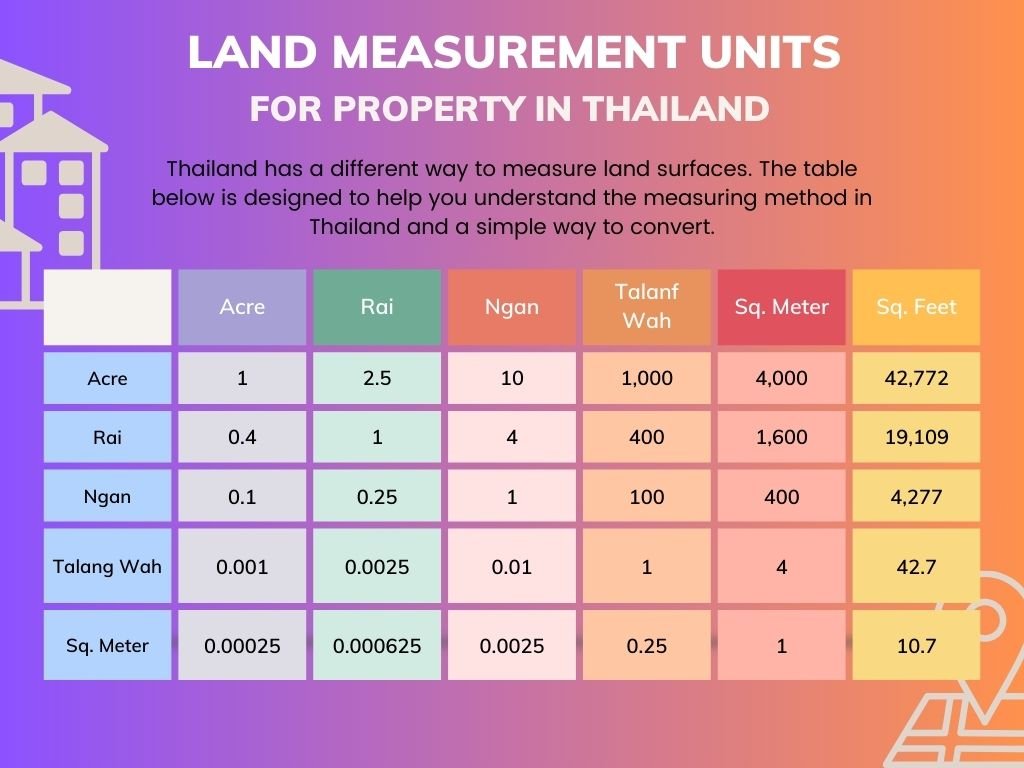
Rai calculations can be confusing, and the wrong calculation can lead to a costly mistake. That is why we put together a Thailand Rai Conversion Calculator for you to use. Feel free to use this calculator for free to convert rai measurements to anything you see in the chart above.
Checking The Title Deed With the Land Department
The best way to do this is to speak to your realtor about finding a legal aid who can guide you and help you get factual information about the title deed.
Upgrading Land Deed Titles
In case an upgrade of title is permitted, the Thai government would carefully examine both the use of the land and the length of the claim. More importantly, upgrading a Tor Bor title or a Sor Kur Nung title takes time and following up with the Land Department, province offices and other government offices.
More often than not these titles can only be upgraded to a full Chanote title in theory and usually buying such land plots is a money pit. In the latest update by the Land Department, it was reported that a Sor Kur Nung title deed can only be upgraded to a Chanote title in court and not directly with the Land Department or any province, or local Thai office.
Upgrading Titles Using Land Reform Program
Depending on the location of the land and also the use of the property, the land reform program allows for an upgrade of the title deed to a Chanote title. However, in such cases, the land cannot be resold and leased for up to 10 years from the date of the newly assigned title deed upgrade. Such plots cannot also be unencumbered for 10 years from the date of the newly assigned title.
Land Squatters And Chanote Title Deeds
In the case of Chanote Title Deeds, if squatters occupy the land for 10 years and if the actual owner of the title deed does not dispute this, then according to Thai law, the squatters can choose to file for a transfer of ownership of the title deed to them. This can be done with a small fee and the owner of the title deed cannot dispute this transfer after 10 years of inactivity in the matter.
Purchasing Chanote Title Deed Properties
The best way to purchase a property in Thailand with a confirmed Chanote title deed and an accurate Rai land area is to choose a reliable Thai-based realtor.